
Silicopat 620 x 420 mm: Plan Spacing for Sugar Decorations
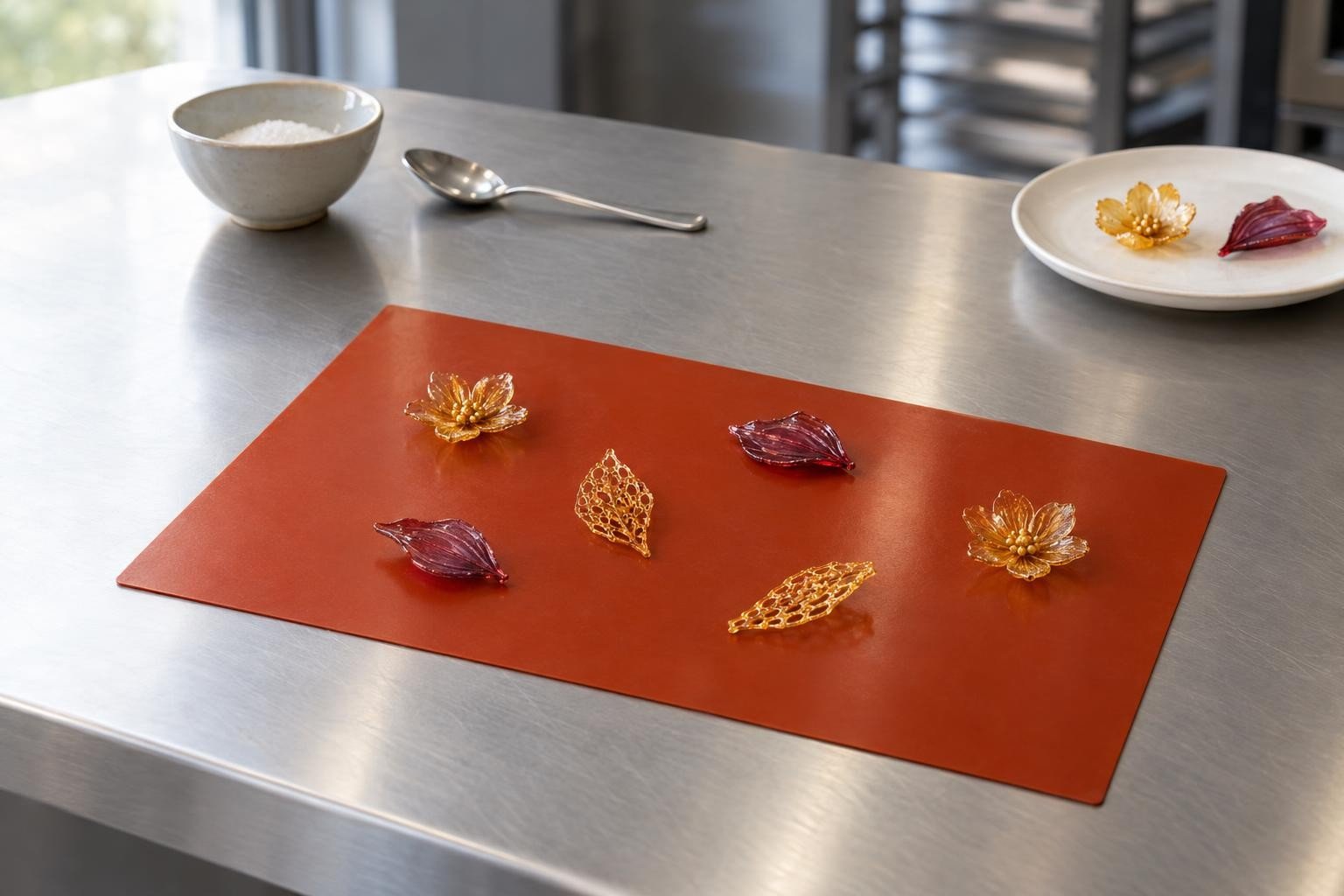
Plan sugar-decoration trials on the 620 x 420 mm Silicopat mat, checking footprint, spacing and release before repeating your layout.
Before you fill your 620 x 420 mm Silicopat mat with sugar decorations, test one piece for spacing and release. Use that trial to establish the decoration’s actual footprint and the access you need to remove it, rather than planning around the outline alone.
The Martellato Silicopat SILICOPAT1/R is a professional nonstick silicone mat for baking, freezing and sugar processing. For this workflow, treat its dimensions as your layout boundary and build your production arrangement from observed results.
By Atmar Horeca team
Define the sugar decoration and its required footprint
Choose one decoration design for your trial. Define the finished outline you want, including any projecting tips or trailing strands. Decide which features must remain intact for the piece to meet your presentation standard.
Sketch the design on a separate planning sheet. Record its intended length and width, but leave room to replace those targets with measurements from the cooled trial piece.
Plan two kinds of space: the area occupied by the decoration and the clear area around it for release and transfer. Do not count an empty-looking gap as available production space until you have checked that you can remove the neighbouring pieces individually.
Set up the 620 x 420 mm mat on a fully supporting surface
Lay the mat flat on a level preparation surface that supports its entire underside, with no edges overhanging. Orient the 620 mm edge left to right and the 420 mm edge front to back so your notes have a consistent reference.
Keep the surrounding bench clear and select a destination for the released decorations before starting. Leave yourself access to the mat’s edges without needing to move it during the cooling and release trial.
| Specification | Provided detail |
|---|---|
| Brand | Martellato |
| Product line | Silicopat |
| Model | SILICOPAT1/R |
| Dimensions | 620 x 420 mm |
| Material | Silicone |
| Surface | Professional nonstick silicone mat |
| Uses | Baking, freezing and sugar processing |
| Reuse | Designed for repeated use in pastry, bakery and foodservice production |
| Pieces per package | 1 |
Trial one decoration before repeating the layout
Make one decoration using your established sugar-processing procedure. Keep it separate from any other trial work, and note where you placed it relative to the front and side edges.
Let the decoration cool fully before assessing release. Compare the cooled outline with your sketch, noting its widest points and any strands extending beyond the intended shape. Measure the actual footprint for your layout record.
Test removal without pulling on a narrow tip or forcing a resistant section. Stop if the piece resists or starts to fracture. Record whether the trial released intact and whether you had enough clear space to approach and support it.
Tip: Record the space needed to release the decoration, not just the space it occupies.
Space, cool and release your decorations step by step
- Map the trial footprint. On your separate planning sheet, draw the 620 x 420 mm boundary and position the outline measured from your first cooled piece.
- Add release clearance. Allow space around the outline based on your removal trial. Include clearance from the mat edges as well as between decorations.
- Test neighbouring positions. Make a small group using the proposed arrangement. Keep the design and your established preparation procedure unchanged while testing spacing.
- Leave the group undisturbed to cool. Keep the mat flat and fully supported. Assess release only after the decorations have cooled fully.
- Release pieces individually. Begin with an accessible outer piece and check that removing it does not require contact with its neighbours. Avoid forcing resistant areas.
- Inspect before expanding. Compare the released pieces with your presentation standard. Repeat the arrangement across more of the mat only after the neighbouring-piece trial is satisfactory.
Troubleshoot crowding and breakage without assuming product limits
If neighbouring outlines touch: increase the planned gap and repeat the small-group trial. Check projecting strands as well as the main body of each decoration. Do not preserve a proposed piece count at the expense of separation.
If pieces remain separate but access is awkward: revise their orientation or leave a wider approach space. Judge the arrangement by whether you can release each piece individually, not by how closely the sketches fit together.
If a decoration breaks: note where the fracture occurred and at what stage. Review the shape, cooling stage and release action separately, changing one variable per trial. Do not treat a failed piece as proof of a product limit.
Record the successful layout for your next batch
Keep a layout record with the model, mat orientation, measured decoration footprint, edge clearance, gaps, row arrangement and release order. Record the number of acceptable pieces actually produced, rather than a theoretical count based only on dimensions.
Add a sketch or photograph to your internal production notes. When you change the decoration’s outline or size, run another single-piece trial before reusing the arrangement.
View the Martellato Silicopat 620 x 420 mm product page to check the details and order it for your pastry operation.
Products in this article

Prices exclude VAT. Open any product above to see when it ships and to order it.
Questions
- What are the dimensions of the Silicopat SILICOPAT1/R?
- The Martellato Silicopat SILICOPAT1/R measures 620 x 420 mm.
- Is this Silicopat mat suitable for sugar processing?
- Yes. The product is described as a professional nonstick silicone mat for baking, freezing and sugar processing.
- How many mats are included per package?
- Each package contains one mat. It is designed for repeated use in pastry, bakery and foodservice production.