
Curvy Snack Mould: Ten Chocolate Bars, No Portion Cutting
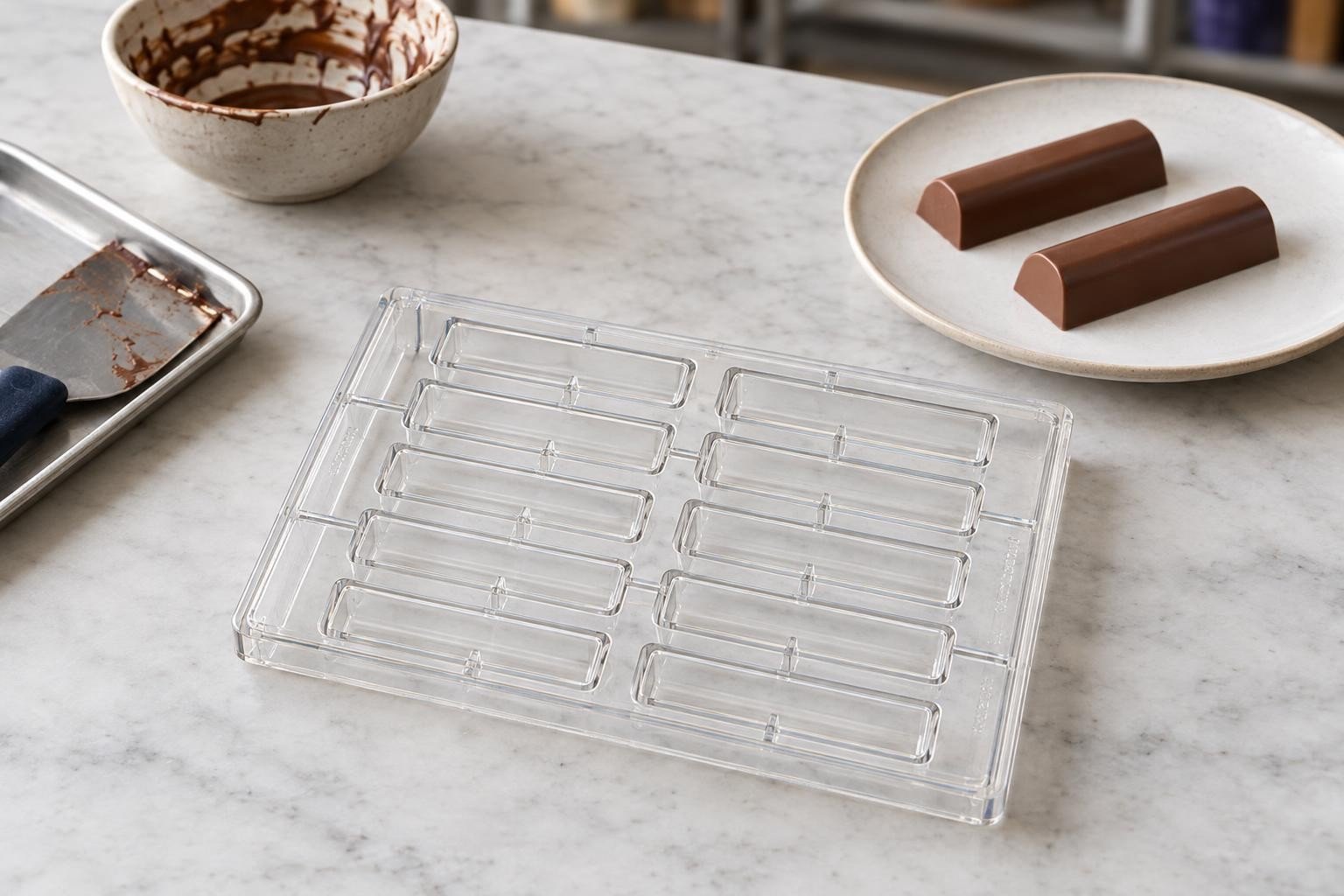
Make ten plain chocolate snack bars in the MA1920, using its approximate 34 g piece weight as a trial guide, not a guaranteed yield.
By Atmar Horeca team
A 96 mm chocolate snack bar served as an individual portion
Use the Martellato MA1920 Curvy Snack mould to make plain chocolate bars that you serve whole. Each finished piece has a stated format of 96 × 22 × 17 mm, so your portion is formed in the cavity rather than cut from a larger slab.
For your first trial, keep the recipe to dark couverture alone. You can assess the curved shape, release and actual piece weight without introducing a filling, inclusions or decoration. The aim is ten individual bars from one filled mould, with one bar served per portion.
Know your mould: ten pieces and approximately 34 g per bar
The MA1920 belongs to Martellato’s Choco Line. It is a transparent polycarbonate mould with a stated productivity of ten pieces. The pack contains one mould, not ten separate moulds.
| Specification | Provided detail |
|---|---|
| Brand | Martellato |
| SKU | MA1920 |
| Line | Choco Line |
| Shape | Curvy Snack |
| Material | Polycarbonate |
| Colour | Transparent |
| Mould size | 275 × 175 × 26 mm |
| Finished product size | 96 × 22 × 17 mm |
| Productivity | 10 pcs |
| Weight per finished product | Approximately 34 g |
| Pack contents | 1 mould |
Treat the approximate 34 g figure as a planning reference. Multiplying it by ten gives approximately 340 g of finished chocolate, but that calculation is not a guaranteed recipe yield. Your first filled and released batch is the point at which to establish the working allowance for your chosen couverture.
Trial-batch ingredients: 400 g dark couverture, including working reserve
- 400 g dark couverture chocolate, including a working reserve for filling and levelling.
This is a trial quantity for one ten-piece fill. Against the approximate 340 g planning total, it provides a nominal 60 g working reserve. That reserve is part of the 400 g ingredient quantity, not an additional ingredient and not chocolate that must be forced into the cavities.
Keep the distinction clear on your production sheet: chocolate prepared is not the same as chocolate contained in the finished bars. Record any chocolate left in your bowl or collected during levelling separately from the released batch.
Numbered method: temper, fill, level, set and release
- Temper. Weigh out 400 g dark couverture. Start with a clean, dry mould and prepare the chocolate using the tempering instructions for your chosen couverture. Follow that chocolate’s specified working conditions rather than assigning a universal temperature to this recipe. Keep the batch plain throughout.
- Fill. Place the mould level on your workbench and distribute tempered chocolate into all ten cavities. Fill each cavity through its full shape rather than making a hollow shell. Gently tap the mould to help release trapped air, then check the cavities and top up where needed.
- Level. Draw a scraper across the mould surface to remove excess chocolate and leave the cavity openings level. Collect the excess separately. Check that chocolate is not bridging neighbouring cavities: you want ten separate bars, not a connected sheet that needs cutting after setting.
- Set. Leave the filled mould level and allow the chocolate to set fully under the conditions specified for your couverture. Do not use a fixed setting time as the acceptance check for this trial. Wait until the bars are ready to release before moving to demoulding.
- Release. Turn the mould over onto a clean receiving surface and gently release the set bars. If a piece resists, check that it has finished setting rather than forcing it out. Count the intact bars, inspect their shape and keep the complete trial batch together for weighing.
Serve one curved bar per portion without cutting
Place one released bar on a plain serving plate and serve it whole. Keep this first presentation undecorated so the Curvy Snack format remains the focus. There is no slab to divide and no portion-cutting stage in this method.
Use the same one-bar serving instruction when you brief your team. Keep the stated dimensions separate from any weight description: the format is specified, while the approximate 34 g figure still needs checking against your own batch.
Tip: Weigh the bars before plating, and record the actual weights rather than copying the approximate catalogue figure.
Weigh the first batch and adjust your chocolate allowance
Weigh each released bar and then the complete batch. Record the number of intact pieces alongside those weights. This gives you a direct reference for your portion specification instead of treating ten times approximately 34 g as a confirmed result.
Compare the finished batch with the 400 g you prepared, noting leftover chocolate and collected excess separately. Use those observations to adjust your next chocolate allowance while retaining enough working reserve to fill and level all ten cavities. Repeat the check before adopting the trial quantity as your production recipe.
Order the Martellato MA1920 Curvy Snack mould from its product page.
Products in this article

Prices exclude VAT. Open any product above to see when it ships and to order it.
Questions
- How many bars does the MA1920 mould make?
- The MA1920 has a stated productivity of ten pieces. The pack contains one mould.
- What are the finished bar dimensions?
- The stated finished product size is 96 × 22 × 17 mm, in the Curvy Snack shape.
- Is each finished bar guaranteed to weigh 34 g?
- No. The provided piece weight is approximately 34 g. It is a trial-batch planning reference, not a guaranteed finished weight or recipe yield.