
Chocolate dipping forks: standardise your praline presentation
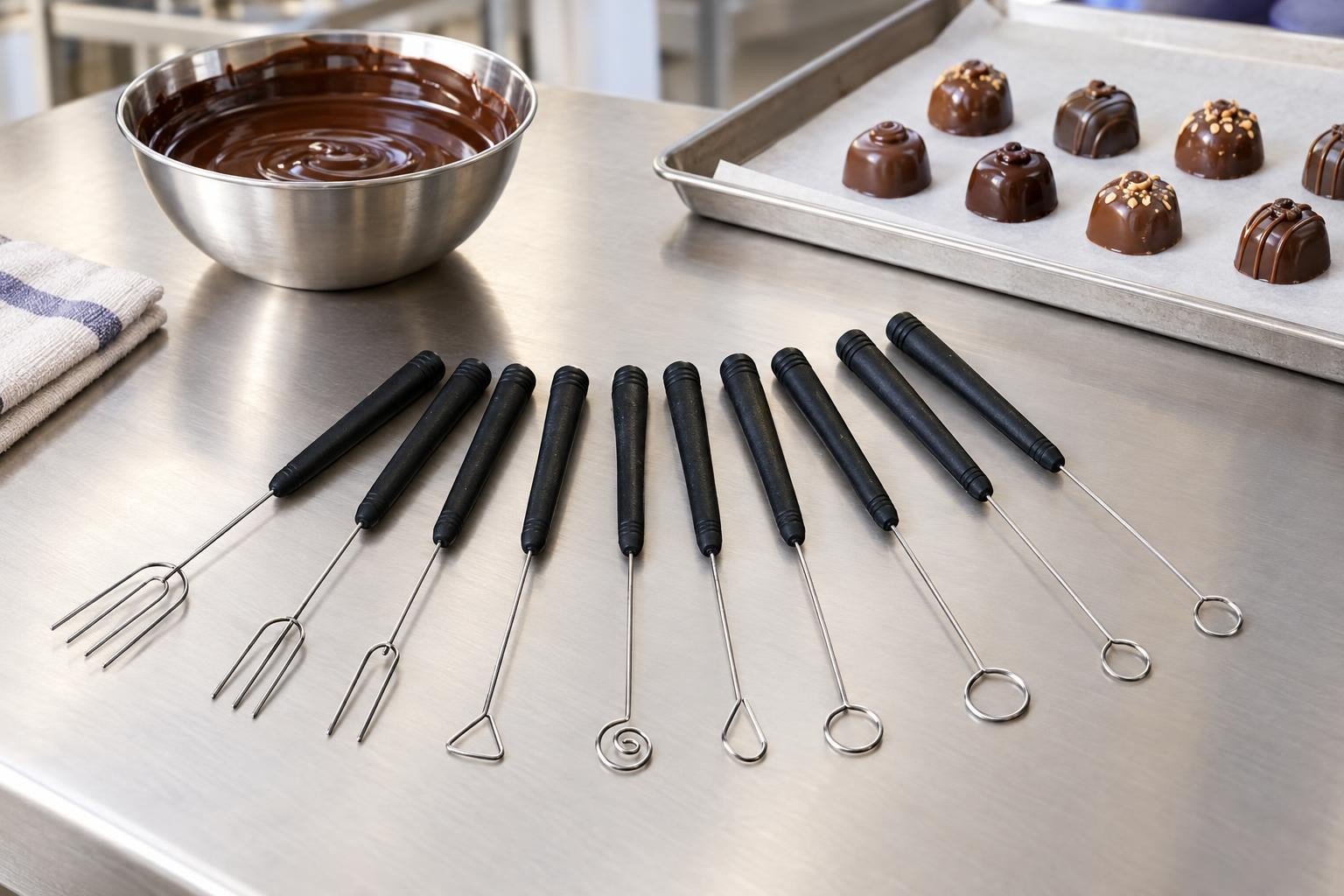
Use the 10-piece Martellato CHOCOFORK set to trial handling and decoration, then define a repeatable finish for your praline selection.
A praline presentation standard starts before you arrange the finished selection. Decide what you want each piece to look like, then trial the handling and decoration needed to repeat that finish. Keep the chosen result as your reference rather than judging each new batch from memory.
The Martellato CHOCOFORK set gives you 10 dipping forks, each 18.5 cm long, for chocolate work. Use your trials to select a tool and movement for each praline, without assuming that a particular fork shape guarantees a particular decorative result.
Define the finish you want across your praline selection
Start with a short visual brief for your own production. Decide whether your selection should share a restrained finish or use distinct decoration for different pralines. Describe the intended appearance in terms your team can check at the bench.
Separate the overall finish from the decoration. First define the appearance you will accept after dipping and lifting. Then decide where any decorative mark should sit, which direction it should face and how prominent it should be.
- Overall appearance: define the outline and visible coating you want to repeat.
- Decoration: specify its position, orientation and intended character.
- Consistency: decide which variations belong within your standard and which require another trial.
Choose a reference piece for each intended finish. Keep your notes specific enough that another member of your pastry team can compare a trial against the same criteria.
Meet the 10-piece, 18.5 cm Martellato CHOCOFORK set
Martellato identifies CHOCOFORK for dipping and extracting fillings in tempered chocolate, and for decorating chocolates and pralines. The forks are made from stainless steel wire with black plastic handles.
| Specification | Provided detail |
|---|---|
| Brand | Martellato |
| SKU | CHOCOFORK |
| Set contents | 10 pcs |
| Length | 18.5 cm |
| Material | Stainless steel wire |
| Handle | Black plastic |
| Listed fork shapes | Triangle, drop, spiral, circular, 2-point, 3-point, 4-point |
| Use | Dipping and extracting fillings in tempered chocolate; decorating chocolates and pralines |
The description lists seven shape names for a set of 10 pieces. It does not specify how those shapes are distributed across the set. Identify the individual forks in your own trial notes rather than assigning quantities to each shape name.
Trial the listed fork shapes for dipping, lifting and decoration
Work with a small trial group before committing to your batch presentation. Keep the intended praline and finish consistent while you compare the forks. Record dipping, lifting and decoration separately so you can see which part of the process needs adjustment.
Include the triangle, drop, spiral and circular shapes in your comparison, alongside the 2-point, 3-point and 4-point forks. Assess each against the same questions rather than giving it a fixed role based on its name.
- Can you position the filling as intended during dipping?
- Can you lift and release the piece with the appearance you have specified?
- Can you repeat the chosen decorative movement across several trial pieces?
For decoration, compare the actual mark with your reference. A circular or triangular fork name describes the tool, not a guaranteed matching pattern on the chocolate. Select your tool from the observed result and your ability to repeat it.
Tip: Change the fork or the movement between trials, not both, so your notes show what you changed.
Arrange finished pralines so their decoration is easy to compare
Lay out your trial pieces in clearly separated groups. Keep pieces made with the same fork and movement together, with the decoration facing the same direction. Use accompanying notes to identify each group without relying on memory.
Compare like with like first. Review one intended praline finish across the different trials before judging the whole selection. Then place your chosen examples together to assess whether their decoration reads as a coherent range.
Keep the arrangement simple during this review. Leave each piece visible rather than building a decorative display that obscures its sides or top. This is a production comparison, so prioritise an unobstructed view of the finish.
Check your presentation before releasing the batch
Return to the visual brief you wrote at the start. Compare the batch with your selected reference pieces, checking the overall appearance as well as the position and direction of decoration. Do not let an attractive individual piece replace the agreed standard.
Record the chosen fork, the handling movement and the decorative action for each finish. Ask another team member to use those notes for a short repeat trial before treating the presentation as established.
Keep any pieces that fall outside your standard separate for review under your own production procedures. Use that review to decide whether your notes need clarification or whether the handling trial needs repeating.
View the Martellato CHOCOFORK chocolate dipping fork set product page for product details and to order it for your pastry lab.
Products in this article

Prices exclude VAT. Open any product above to see when it ships and to order it.
Questions
- How many forks are included in the Martellato CHOCOFORK set?
- The set contains 10 dipping forks, each 18.5 cm long.
- Which fork shapes are listed for CHOCOFORK?
- The listed shapes are triangle, drop, spiral, circular, 2-point, 3-point and 4-point. The supplied description does not specify the quantity of each shape.
- What are the CHOCOFORK dipping forks made from and used for?
- The forks are made from stainless steel wire with black plastic handles. They are designed for dipping and extracting fillings in tempered chocolate, and for decorating chocolates and pralines.